Border crossings in Africa can be interesting and challenging. If you are prepared you will find them easy. Always remember the golden rule. Be kind and patient and use this guide to prepare yourself. Also take note that border crossings are not all the same but in general they work as per this guide. Sometimes the officials at the border may be asking you for extra information or sometimes they will just wave you through. I deal with two categories of borders. 1 to 4 and then 5 and above. These comments are based on my 1000 plus border crossing I have made over the years.
Border Crossing Level of Difficulty in Crossing :
( 1 to 10, 1 being easy, 10 most difficult )
- Namibia – 1
- Botswana – 1
- Lesotho – 1
- Swaziland – 1
- Zambia – 5 ( the ferry crossing makes this interesting / bridge now in use )
- Zimbabwe – 6
- Mozambique – 5
- Malawi – 7
- Tanzania – 7
- Kenya – 8 – Carnet needed
- Rwanda – 8
- Burundi – 8
- Uganda – 8
- DRC – 10 – Carnet needed
- Angola – 8 – Carnet needed
- Gabon – 10 – Carnet needed
You will find that borders rated between 1 and 4 are fairly modern borders, which are well marked and does not have runners and stalls. They are organised and in general a pleasure to cross.
Borders rated at 5 and above have stalls, fixers and are in general poorly marked so you do not know where to go and you are not sure if you have cleared all the required stations. Be kind and patient.
What about Trucks and other commercial vehicles ?
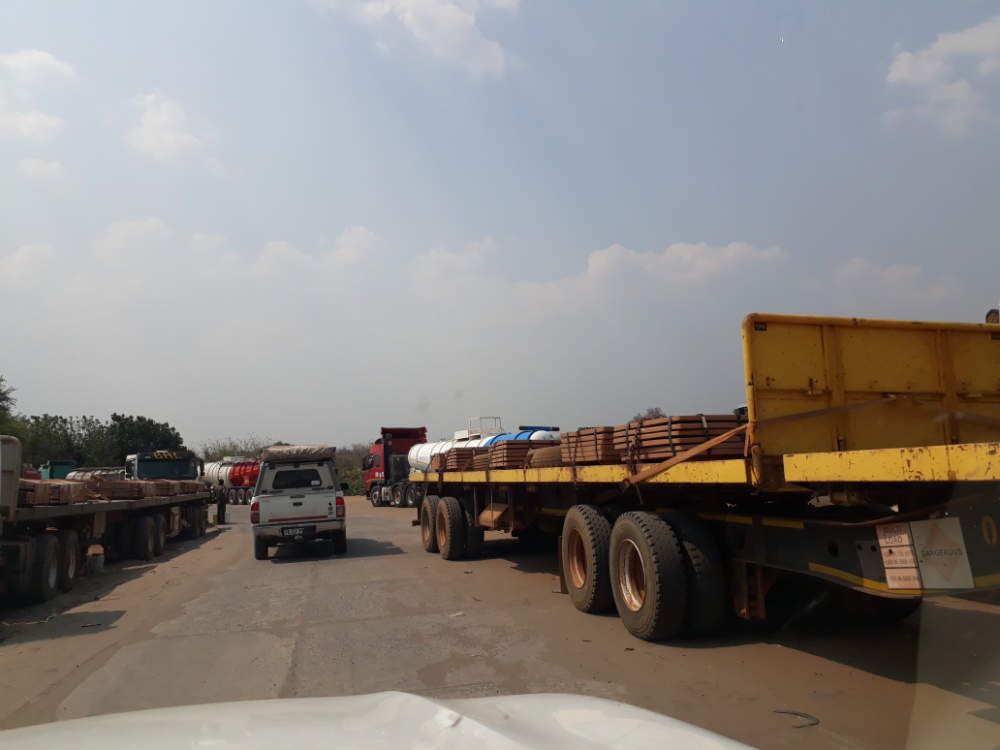
When approaching the border you will see trucks and commercial vehicles lining up to cross the border. Most borders have their own lane and checking area. You can drive pass them and stop at the light motor vehicle parking which is normally situated at the front of the office building where immigration, customs and other formalities are housed.
Use a Fixer
For borders rated 5 and above use a fixer to assist you. Also take note that some of the borders you will find that all the offices are not under the same roof and that you will have to walk from building to building to formalities done. These buildings are mostly not marked and you will need a fixer to point them out. The fixer will also assist you to jump the queue and get you faster cross the border. In my opinion money well spent.
I will know in advance that you will be crossing a 5 plus border and I will share my fixer’s telephone contact. You are welcome to use this nominated person or if you wish to get your own fixer at the border.
When stopping at the border you will be swamped by a lot of people that want to sell you insurance, exchange money or assist you with the border crossing. Identify one person and chase the others away. Negotiate with this one person on what needs to be done and what it will cost you. Normally the guys at the border will state one fee which includes his service fee. Ask this person to break down the cost for you to ensure you are not being overcharged. He also needs to make a living and in general I find that a 20 US$ fee for assistance is a fair payment. Make sure you know what he looks like and what his name is. I always take a photo of the fixer with the as to capture the border crossing experience. It is also a good way to ensure you have a record should your fixer walk away with your money. Agree on the fees. Give your fixer the cash as requested or go with him for the card payments. Before exiting the border make sure you have all your documents ( TIP, 3rd Party Insurance, Road Taxes, Council Levy ). Check them yourself. Make sure they are correctly filled out ( your name is correct; vehicle registration is correct ) as you can still have it fixed at the border. Be kind and patient.
Flow of traffic
Border can be one right next to each other ( Komatipoort / Ressano Garcia ) or you may need to drive a distance between the borders ( Ariamsvlei / Nakop borders )
All borders have more or less the following flow. Sometimes the border officials will leave out some of the steps, just check with the person if all is ok before leaving and sometimes, they may add an additional step. One of the additional steps I find that the South African borders do from time to time is to get you to stop at the South African Police Services to check if your vehicle is not stolen. Cooperate and assist where you can. You are on holiday and make a border crossing part of the experience. Be kind and patient.
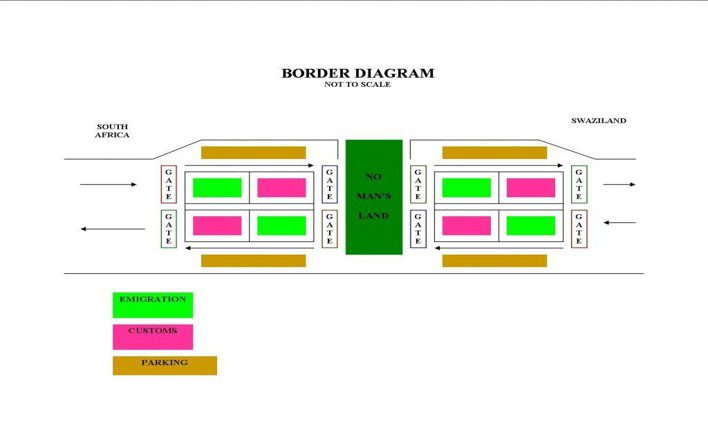
Diagram Explanation
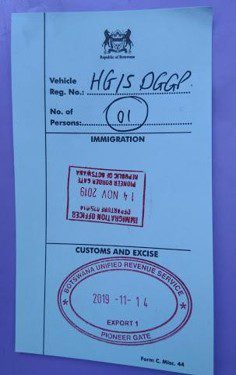
Let’s use the diagram and we are travelling from South Africa to Swaziland. At the gate you stop, collect Gate Pass ( Sample below ). Stop in front of the offices. Clear emigration. Clear Customs. Have them stamp your gate pass. Pay at the pay gate ( usually situated at the Customs side ) for any fees due. Stop at the exit gate. Hand in your Gate Pass. Now you are out of South Africa. Repeat to enter Swaziland.
Documents at the border
We supply what we call the 5 page border pack. This will get you through any borders. Borders rated 5 and above will have a Police Clearance for the vehicle to assist you. For Kenya and West Africa a Carnet de Passage ( Carnet ) will be supplied.
5 Page Border Pack :
- Letter of Authority to use the vehicle
- Copy of the NATIS ( registration document ) of the vehicle
- Letter to confirm insurance
- Letter from the bank to give permission that the vehicle is allowed to cross the border
- Copy of the ID of the person who prepared all these documents . Usually me, Carel Pienaar.
Border Gate Pass
As you drive in at the gate of the border you will be given a slip that needs to be stamped by Emigration and Customs. Sometime this slip will be available at the Customs counter. On exiting the border the exit gate will check this slip and ask for it. It is returned to the border gate official. This process is repeated at the next country gate.
Third Party Insurance / 3rd Party Insurance
All countries you enter raises a 3rd party insurance fee. This is payable by the driver of the vehicle and can be paid by card ( Master and VISA only ) and cash (usually the local currency). That is why there are money exchangers at the borders to exchange. They give horrible rates so exchange only enough for the border crossing. Draw cash at the ATM once in the country for the use of your holiday.